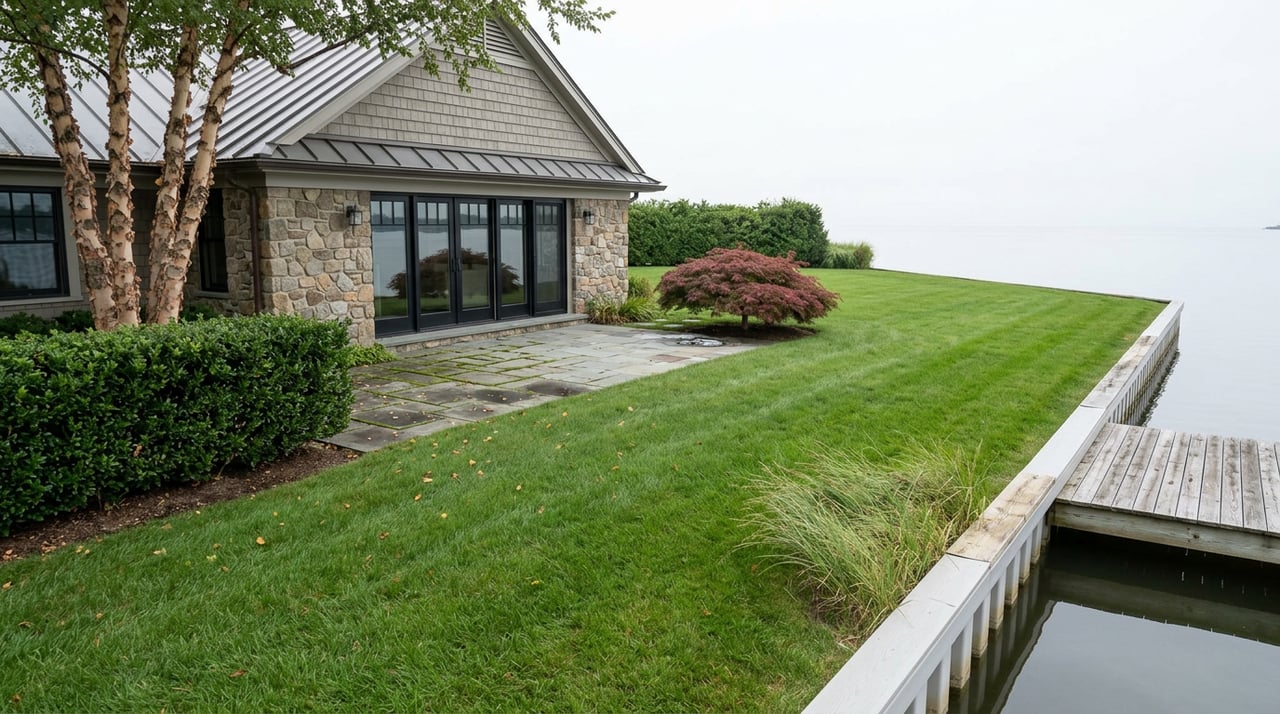
A home inspector walking through a canal-front property in South Merrick will check the attic insulation, run the furnace through a cycle, test every outlet, and photograph any hairline crack in the foundation. Standard practice, thorough by design. Then the inspector steps into the backyard, glances at the water, and moves on. The vertical wall holding the entire yard back from the canal rarely gets more than a visual once-over, because most home inspectors are licensed to evaluate structures, not marine construction.
That gap matters more in Merrick than almost anywhere else on the South Shore. South Merrick and the canal blocks feeding Merrick Bay and East Bay are built around private waterways, and listing descriptions for these homes almost always mention the bulkhead somewhere in the remarks: a certain number of feet of re-surfaced bulkhead, a note that it's PVC, a year stamped next to the word like a birthdate. What those listings rarely explain is what that phrase is actually telling a buyer about the next decade of ownership costs. The material behind that wall, not its cosmetic condition on a Sunday showing, decides whether the next owner inherits forty years of stability or a repair bill that lands within the first few years.
The Math a Listing Photo Won't Show You
Bulkhead work on Long Island falls into two very different cost categories, and the gap between them is the whole story. Targeted repairs, current 2026 pricing from a marine contractor serving Merrick and Wantagh waterfront clients puts spot repairs at $100 to $250 per linear foot, with most residential jobs landing between $3,000 and $8,000 total. Full replacement is a different order of expense entirely: $500 to $1,200 per linear foot.
Run that against the actual footage seen on recent South Shore canal listings. Homes have advertised 63 feet of bulkhead, 68 feet, 90 feet, 127 feet. A 100-foot run, which is a reasonable middle estimate for a canal lot in this stretch of Merrick, turns into a $10,000 to $25,000 repair if the structure is basically sound, or a $50,000 to $120,000 replacement if it isn't. Nobody puts that range on a listing sheet, and the difference between the two outcomes usually comes down to one inspection nobody ordered.
A bulkhead's age on paper tells you when it went in. It doesn't tell you what it's made of, and that's the only number that predicts what you'll pay next.
Same Install Year, Different Clock
Here's the mechanism that makes this a genuine blind spot rather than routine due diligence. Vinyl sheet piling, now the standard choice for residential shorelines on Long Island, resists rot, marine borers, and saltwater corrosion well enough to run 50 to 60 years or more with minimal upkeep. Pressure-treated timber, the historical default, typically lasts 10 to 25 years, and its position has weakened further since environmental rules restricted some of the chemical treatments that used to extend wood's life against marine conditions.
That means two bulkheads installed in the same year, sitting on neighboring canal lots in Merrick Gables or South Merrick, are not comparable assets just because a listing says "bulkhead 2010" for both. One could have four decades of useful life left. The other could already be approaching the point where resurfacing stops being an option and full replacement becomes the only path.
| Vinyl Sheet Piling | Pressure-Treated Timber | |
|---|---|---|
| Typical lifespan | 50 to 60+ years | 10 to 25 years |
| Maintenance needs | Minimal | Ongoing, increasing with age |
| Vulnerable to | UV degradation over decades | Rot, marine borers, restricted treatments |
| What it signals to a buyer | Long runway before major capital cost | Shorter window before replacement decision |
A listing that specifies "PVC bulkhead" is doing a buyer a favor most sellers don't realize they're offering. A listing that just says "bulkhead" with a year is withholding the one data point that actually matters.
The Permit Clock Hiding Behind the Repair Estimate
Even when a bulkhead clearly needs work, the fix isn't a weekend project you schedule the way you'd schedule a roof repair. New York's Department of Environmental Conservation regulates bulkhead replacement across Nassau and Suffolk counties under a general permit, currently GP-1-22-001, in effect since 2022. It covers in-kind, in-place replacement of a functional, lawfully existing bulkhead, and it excludes high wave energy areas and vegetated tidal wetlands, so not every canal parcel automatically qualifies for the streamlined path.
The application still requires a site survey showing the existing structure and three dated color photographs of the project site, and the permit only stays in the fast lane if the work stays in-place or moves landward. Re-sheathing is allowed with a small seaward tolerance: up to 4 inches for timber boards, up to 8 inches for corrugated materials like vinyl or steel. Push past that, or propose any expansion into the water, and the project shifts into individual permit review, which can also pull in the Army Corps of Engineers and a New York State coastal consistency review. What started as a repair estimate becomes a paperwork timeline measured in months, not weeks.
There's a useful upside buried in the same rule. The permit also allows a replacement bulkhead to be built up to 18 inches higher than the one it replaces, or higher still if the local FEMA flood elevation justifies it, without triggering extra review. For a seller thinking about resilience upgrades before putting a canal home on the market, that's a meaningful option to raise with a marine contractor early, not after an accepted offer.
Why This Isn't the Flood Insurance Conversation
It's worth separating this from the flood-zone conversation that usually comes up first with canal properties. A home's flood zone designation and insurance premium are about FEMA's maps and the elevation of the structure itself. The bulkhead is a completely different asset, governed by DEC and Army Corps rules rather than insurance underwriting, and its condition has nothing to do with whether the house sits in an X zone or an AE zone. A property can carry low flood insurance and still be sitting behind a bulkhead that's three years from needing full replacement. Treating the two as the same conversation is how this detail gets missed on both sides of a transaction.
What to Ask Before You Write the Offer
For a buyer looking at a canal-front home in Merrick, the questions worth asking before submitting an offer are specific and easy to overlook in the excitement of a waterfront showing:
- What material is the existing bulkhead, and does the seller have documentation, not just a verbal answer
- When was it last replaced versus resurfaced, since those are different events with different remaining lifespans
- Is there any permit history on file with the town or DEC for prior bulkhead work
- Has a marine contractor ever assessed the structure, separate from the general home inspection
For a seller, the calculus runs the other way. If the bulkhead is aging timber, deciding whether to address it before listing, rather than leaving it as a post-inspection negotiation point, can be the difference between a clean closing and a price reduction that gets litigated line by line at the eleventh hour. Given that permitted work has its own lead time, that decision is better made months before a listing goes live than during an attorney review period.
A Few Questions Worth Asking Early
Does a standard home inspection cover the bulkhead? Not in any meaningful structural sense. Most licensed home inspectors will note visible condition but aren't trained or insured to evaluate marine construction the way a marine contractor would.
If the bulkhead needs work, can it just be resurfaced instead of replaced? Sometimes. DEC's general permit allows re-sheathing with a small seaward tolerance, which is a lower-cost path than full replacement when the underlying structure is still sound. Whether that's an option depends on the material and how far along the deterioration already is.
Does raising the bulkhead during a repair help with flood risk? It can. The same permit that governs replacement allows the new structure to sit up to 18 inches higher than the old one, or higher if justified by the local FEMA flood elevation, without extra review. It's a decision worth raising with a contractor before the work starts, not after.
None of this shows up on a listing sheet, and most of it never comes up until an inspection contingency is already ticking. If you're weighing a canal-front home in Merrick, whether you're buying into South Merrick's waterfront blocks or getting ready to sell one, Robyn Goldowski can walk through what a specific property's bulkhead history actually means for your offer or your asking price, and connect you with the right marine contractor before it becomes a surprise instead of a plan.